
 Home
Home
Royal Aspiration
“Chulabhorn Royal Academy was established in dedication to His Majesty King Bhumibol Adulyadej The Great, in accordance with His royal aspiration to ensure good health and a quality standard of living for all. The Academy serves as a center of education, research, and medical services, dedicated to developing professionals in medicine, science, public health, and the environment who are committed to serving society with integrity, compassion, and professional excellence. Chulabhorn Royal Academy provides medical services of international standards on a non-profit basis, with particular emphasis on supporting the underprivileged, in order to enhance the quality of life of the Thai people.”
Professor Dr. Her Royal Highness Princess Chulabhorn Krom Phra Srisavangavadhana
President of Chulabhorn Royal Academy, Chancellor of Chulabhorn Royal Academy Council, and Acting Secretary-General of Chulabhorn Royal Academy


Secretary General's Message
History of Chulabhorn Royal Academy
Driven by the profound vision of Professor Dr. Her Royal Highness Princess Chulabhorn Krom Phra Srisavangavadhana, who is dedicated to ensuring that all citizens enjoy “good health and a high quality of life,” and in continuation of the royal resolution of His Majesty King Bhumibol Adulyadej The Great, Chulabhorn Royal Academy (CRA) was established in 2016. Operating as a public agency under the supervision of the Office of the Prime Minister, the Academy serves as a premier center for education and research. Our mission is to produce graduates and develop professionals in medicine, science, public health, technology, and environmental studies. We nurture individuals who are committed to prioritizing the well-being of others before their own, guided by morality, ethics, and a spirit of volunteerism, while actively preserving arts and culture. We provide social services with professional expertise and excellence for the benefit of every life in society. Furthermore, as a non-profit medical institution, the Academy delivers international-standard healthcare to the public, ensuring sustainable service to humanity—particularly for the underprivileged—to elevate the quality of life for all Thai people. I, In accordance with the Chulabhorn Royal Academy Announcement on the “Establishment and Definition of Duties of CRA Divisions, B.E. 2568 (2025),” and the Establishment and Definition of Duties of CRA Divisions (No. 2), B.E. 2569 (2026), the Academy is structured into nine primary divisions:
- • Office of Chulabhorn Royal Academy
- • HRH Princess Chulabhorn College of Medical Science
- • Chulabhorn Hospital
- • Faculty of Health Science Technology
- • Princess Agrarajakumari Faculty of Nursing
- • Princess Srisavangavadhana Faculty of Medicine
- • Faculty of Science
- • Faculty of Food and Nutrition Innovation
- • Faculty of Engineering



Philosophy
Be Excellent for Lives
อคฺโคหมสฺมิ โลกสฺส เสฏฺโฐหมสฺมิ โลกสฺส
Resolution
Excellence in Education and Research for Humanity
Vision
Equitable Well-being through Science and Innovation

Missions
01
Education - To provide education that develops leaders and professional researchers in health sciences, science, medical technology, public health, and environmental studies.
02
Research and Innovation - To conduct research and generate knowledge and innovations in health, science, medical technology, public health, and the environment that are practically applicable and capable of guiding and driving national and societal develo
03
Academic and Professional Services - To deliver excellent and equitable academic and professional health services, ensuring fairness, inclusiveness, and the reduction of inequality in society.
04
Organizational Excellence - To manage the Academy as an efficient, continuously improving organization, striving toward excellence at the international level.
05
Cultural Preservation - To preserve, promote, and sustain arts, culture, religion, moral values, and local wisdom.
06
Royal Aspiration and Social Commitment - To uphold the royal aspiration of serving the people with perseverance, compassion, and a strong commitment to the public good.

CRA Anthem
HRH Princess Chulabhorn Krom Phra Srisavangavadhana
"The People’s Princess"
CRA's Flower
Phalaenopsis Princess Chulabhorn



Phra Buddha Sirinaka Bhaisajyaguru Chulabhorn

Phra Buddha Sirinaka Bhaisajyaguru Chulabhorn is the presiding Buddha image of Chulabhorn Hospital. The design was conceived under the royal guidance of Professor Dr. HRH Princess Chulabhorn Krom Phra Srisavangavadhana and sculpted by Nonthivathn Chandhanaphalin (2006 National Artist in Visual Arts - Sculpture).
The Buddha image features a contemporary applied style, influenced by the iconography of
Phra Bhaisajyaguru Vaitoonprapha (the Medicine Buddha). It is depicted in the Naga Prok attitude (sheltered by the Naga’s hood), holding a medicine pot in the palm of his hand. According to Mahayana Buddhist belief, "Bhaisajyaguru Vaitoonprapha Tathagata" is the Buddha of Healing. He attained enlightenment to deliver all sentient beings from illnesses and alleviate physical pain, mental suffering, and karmic ailments of humanity.
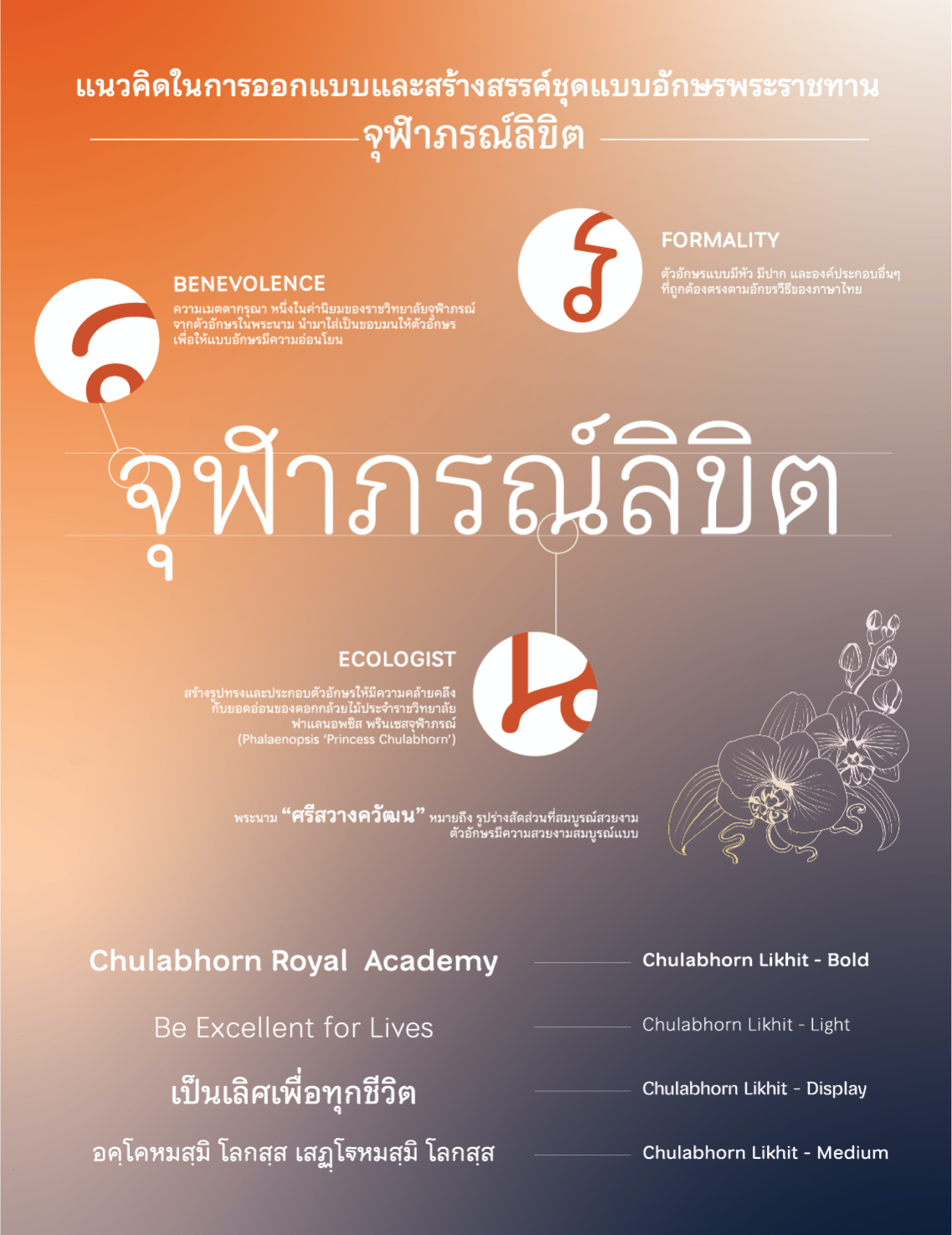
The Official Font of CRA granted by
HRH Princess Chulabhorn Krom Phra Srisavangavadhana
The Font is created for commemoration of the 63rd Birthday Anniversary of
Prof. Dr. HRH Princess Chulabhorn Krom Phra Srisavangavadhana.
The Font has both beautiful Thai and Standard English complete alphabets and characters,
orthographically correct and can be used in both general documents and display topics.
C
Commitment
H
Honesty
U
Unity
L
Loyalty
A
Altrurism
B
Benevolence
H
Happiness
O
Opportunity
R
Research
Excellent
and
Innovation
N
Networking
Chulabhorn Royal Academy Act, B.E. 2559 (2016)
Section 6
Section 6 of the Chulabhorn Royal Academy Act, B.E. 2559 (2016) stipulates that Chulabhorn Royal Academy shall be higher research and academic institution and shall provide academic and professional education in the fields of science, technology, environment, medicine, and public health.
The objectives of the Academy are to conduct research; create, compile, apply, promote, disseminate, and develop knowledge; manage education; and produce highly qualified professionals in order to generate new knowledge and serve as a center of excellence in science, technology, environment, medicine, and public health. The Academy shall also provide medical and public health services to the public, offer assistance to the underprivileged and disaster-affected individuals, and promote moral integrity, ethical conduct, and the preservation of arts and culture.
Section 7
In achieving the objectives under Section 6, Chulabhorn Royal Academy shall give due consideration to the following principles:
(1) Moral integrity and ethical conduct
(2) Equity in access to educational opportunities
(3) Academic excellence and academic freedom, with standards and quality recognized at the international level
(4) Transparency and accountability to the State and society
(5) Efficiency and effectiveness in administration and management
(6) Participatory management, involving personnel of the Academy in organizational governance